Categorie: English

  • Am I like Hitler?

    Am I like Hitler?

    During an event organized by Metaforum (KU Leuven), I had the opportunity to reflect and speak, drawing on my own experience, about how we can make the university more accessible to everyone. I offered an autistic perspective.

    Nederlandstalige versie

    Today, I want to share a story about a question that has stayed with me over the past few weeks. It’s a question I would never have come up with myself, but it suddenly appeared in newspapers, on television, and online. It’s uncomfortable, strange, and perhaps even dangerous, but I tried to answer it as honestly as I could.

    The question is: “Am I like Hitler?”

    Why would I even think such a thing? Not because of my own values or actions, but because I am autistic, and because a recent documentary suggested that Hitler might also have been autistic. The documentary analysed Hitler’s DNA and reported that he had a higher “risk of autism” than the general population. The research behind the documentary is scientifically grounded, but the results were presented in a scientifically weak manner. And, more importantly for this evening, it planted a troubling idea: that autism might somehow explain the atrocities Hitler committed.

    When you watch the documentary, it is easy to forget that it presents a hypothesis, not a diagnosis. It offers no historical certainty and certainly no moral explanation. What it reveals most clearly is how quickly we use DNA to invent stories about people – how readily we treat biology as character, as guilt, as danger. That’s basically Hitler’s language in a new form: the language of eugenics.

    So tonight, I want to reflect and consider what is supposedly the same between Hitler and me.

    What is the same? We are both human. That sounds trivial, but it is the start of every discussion on diversity. Autism does not change a person’s humanity. It changes how information is processed, not the fundamental worth of a human life.

    What else? We both grew up in environments that could not always, or did not always want to, support us. I have known this feeling my whole life, and I have felt it here as well, at KU Leuven. For example, accessibility seems to depend on accidental happenings and policy decisions. During COVID, lectures were streamed and recorded, and suddenly studying became possible for many students with disabilities without a lot of extra barriers. But once the crisis ended, these streams and recordings disappeared again. It would be easy to keep streaming and recording, the equipment is still there. It is a quiet form of exclusion, but one with a significant impact on many students.

    Hitler grew up in an environment where exclusion was far harsher and more brutal. He grew up in a world that offered little to no room for vulnerability, human differences, or failure. This raises yet another question: “What if Hitler had felt welcome as a human being, before ideology gave him a different way of purpose?” This question does not change his horrendous crimes, but it does show how essential an inclusive environment can be for anyone growing up today.

    What else do we share? Strong interests and intense focus. For me, that shows up in my research. I finally found a way to contribute to knowledge and to society in a way that fits me, after many failures in jobs where I simply couldn’t stay. Hitler’s intensity, however, was eventually directed toward ideology, power, and destruction. That difference lies not in our DNA; it lies in context, ethics, and choices.

    Another similarity: social communication works differently for both of us. I sometimes struggle to convince people of my story, because I think mainly in terms of content, not social strategy. I suspect Hitler also struggled with social strategy, but he compensated with authority and propaganda, heavily supported by his environment. The same vocabulary might apply, but the lived reality is worlds apart.

    Another connection is that eugenics plays a large role in both our lives, though in completely different ways. Eugenic thinking (the idea that we can breed a “better” human being) still shapes how people talk about autism today. Thankfully not yet through totalitarian programmes, but through more subtle questions like: “Which abnormalities should we detect during pregnancy? Which lives do we consider desirable? Which forms of human variation do we allow, and which do we quietly reject? What if my child will be “difficult”?” These are not neutral questions. They shape how safe people can feel in their own existence.

    And that brings me to the core message. If you watch the documentary, remember that autism does not explain hatred, ideology, fascism, or genocide. Autism is a neurobiological variation. Nothing more, nothing less. Hitler’s actions did not arise from his DNA, but from political convictions, historical conditions, and moral choices. Those do not live in our genes.

    By asking the question “Am I like Hitler?” out loud, and in front of an audience no less, I hope to show how absurd the question truly is. And how dangerous it is that the question can still be asked seriously. Because it reveals how easily our society still ranks traits as “normal” and “abnormal” instead of understanding them as diversity. As if variation itself were already a threat.

    Inclusion means the opposite. It means that differences are not arranged hierarchically. That the line between “normal” and “different” is not biological, but cultural. Inclusion is not charity, and it is not tolerance. It is not “we will include you if it doesn’t inconvenience us.” It means building societal structures broad enough to hold our differences without trying to erase them.

    This is where a meaningful link with Hitler appears: he symbolizes what happens when a society rejects diversity. When differences are treated as defects. When biology becomes a tool for ranking human beings. When “normality” becomes a political project, variation becomes a danger.

    So, the real question was never whether I resemble Hitler. The real question is why our society so quickly attaches moral meaning to biology. Why we are so eager to read differences as moral judgements. Why the idea persists that some forms of human variation ideally should not exist.

    I would like to end with a minute of silence. Not for Hitler. Not for me. Not for pity. But to take a moment to consider the assumptions we all carry with us, the reflex to moralize traits, the speed with which we draw conclusions about people based on biology.

    And so I return the question back to society: “Are you like Hitler? How quickly do you let biology determine the value of a human life? How do you choose to see diversity in a society that claims to be just?”

    And finally, I ask you to not applaud after this talk. Applauses closes discussions. I hope silence will open one.

    ——- silence ——-
  • Tomorrow is Pig Day

    Tomorrow is Pig Day

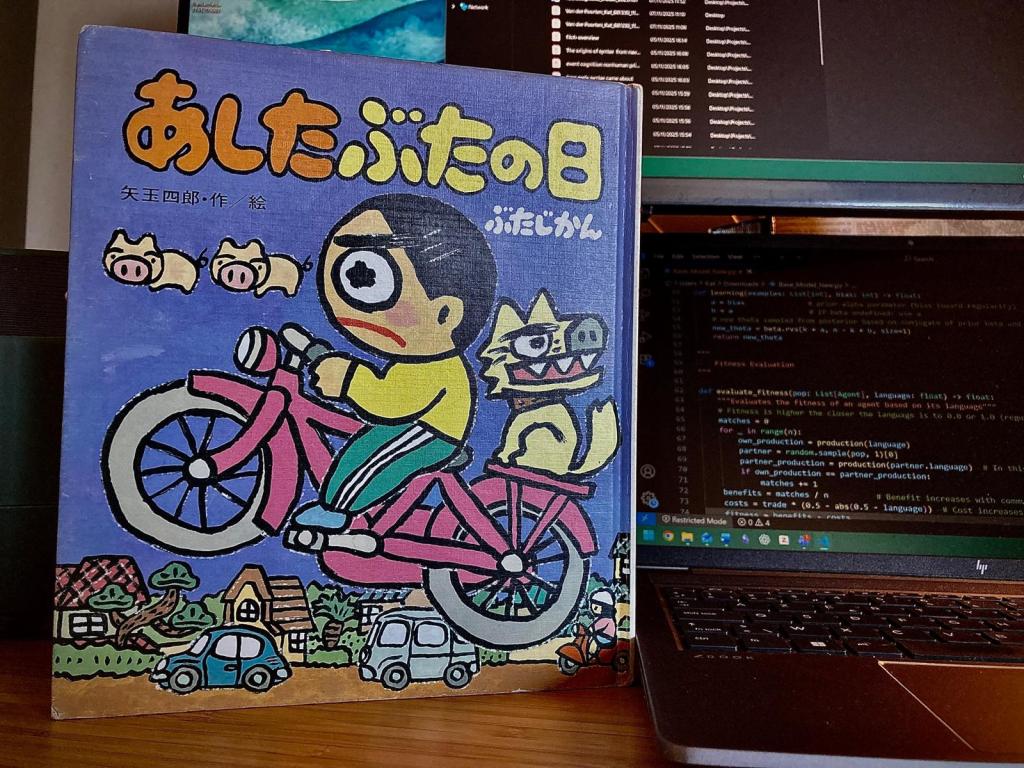
    In a Japanese children’s book titled Ashita Buta no Hi (あしたぶたの日) – Tomorrow is Pig Day – author and illustrator Yatama Shirō constructs a world that quietly collapses under its own absurdity. The story begins in the ordinary as a young boy narrates his day. Then, without warning, pigs begin to appear: in classrooms, on the street, in the sky. They multiply and invade every corner of daily life.

    The boy, accompanied by his irritable dog (who, for reasons never explained, has the snout of a pig), tries to carry on as if reason still applies. But every attempt to impose order only deepens the chaos. By the final page, he stops resisting. “Tomorrow is Pig Day,” he declares, not as prophecy or celebration but as resignation. The absurd has become routine.

    Yatama’s work belongs to a lineage of Japanese ‘nonsense literature’ (ナンセンス文学), a form that embraces the collapse of logic as both comedy and critique. Beneath its cartoonish surface, Ashita Buta no Hi reads like a parable about systems that no longer serve meaning – where procedure has replaced purpose, and survival requires a wry acceptance of incoherence.

    For anyone who has spent time inside modern academia, this story feels eerily familiar.

    The academic world promises order, inquiry, and the shared pursuit of knowledge. Yet its daily reality more resembles Yatama’s Pig Day: endless activity, little coherence, and an undercurrent of collective frustration. Researchers scurry between deadlines, grant applications, and publication quotas, all while claiming to serve the ideal of truth. The system generates an extraordinary volume of output but starves genuine curiosity. Everyone is busy; few are allowed to truly think.

    The irony is that these structures were designed to sustain intellectual life, yet they now constrain it. Departments and disciplines have become pens; each filled with researchers rooting in their own patch of soil, often unaware that the pen next door houses others asking the same questions. The very architecture of academia isolates rather than connects, rewarding specialization over synthesis.

    Interdisciplinarity – the fragile art of crossing boundaries in search of deeper understanding – does not thrive under such conditions. It requires patience, dialogue, and uncertainty: all things our institutions have learned to treat as inefficiencies. The logic of productivity demands measurable outcomes, and so we measure the measurable. Tomorrow is Pig Day again.

    In Yatama’s story, the boy’s anger is not petulance but lucidity. He sees that the world around him has stopped making sense and refuses to pretend otherwise. That is a scholar’s task too: to stay awake in the absurdity. To keep pointing to the incoherence, even when the system insists it is normal.

    Perhaps that is the only kind of resistance still available: to continue asking real questions in a world too busy to listen. We can insist that inquiry is not a product, that wonder is not inefficiency, and that the value of knowledge lies not in output but in the questions that refuse to be domesticated.

    If tomorrow must be Pig Day, then let it at least belong to those who still notice the pigs.

  • LAVA Scholarship 2025 English

    LAVA Scholarship 2025 English

    I want to thank the jury and everyone at LAVA. This recognition means far more to me than simply support for my research.

    The road up until now hasn’t always been easy, and I’ve had many moments of doubt. Times when I wondered if there was a place for me anywhere at all.

    Fortunately, I did eventually find that place: where I can be my authentic self and where my way of thinking is not only accepted, but also valued. Where I can contribute as I am. This scholarship therefore feels like further confirmation that I’m not just allowed to exist in the academic world, but that I truly belong there.

    Before I say something about my research on the evolution of structure and meaning, I want to thank everyone I’ve met along the way. Far too many to mention all by name, but there are two people I’d like to call out specifically: my supervisors, Piet van den Berg, Professor of Evolutionary Biology at KU Leuven, and Shigeru Miyagawa, Professor of Linguistics at MIT.

    Thank you for the opportunity, the trust, and the freedom to pursue my own curiosity.

    Last academic year it quickly became clear that my master’s thesis would get a sequel. The many ideas were already in place, but the self-confidence was still nowhere to be found. Thanks to Piet, I eventually overcame my fear, and together with him, I wrote an FWO application for a doctoral grant, even though I was convinced I’d never survive the selection process with my weird academic profile. Now, I can continue for at least another four years. And hopefully much longer.

    Thanks to Miyagawa-sensei, I am able to start a research internship in Japan on April 1. He put me in touch with researchers at Osaka University, making it possible for me to join the lab of Professor Takufumi Yanagisawa and work together with the team there to uncover the neurobiological origins of language.

    先生方、この貴重な機会をいただき、心より感謝申し上げます。

    Part of this research internship is funded by the FWO, my official employer, but thanks to LAVA, I can realize even more of my ambitions in Japan. I hope that I will be able to honour this scholarship and the autistic community.

    My research stems from my childlike sense of wonder and curiosity. I wanted to be able to talk to animals so badly, and when I realized that mutual conversations with my hamsters were probably a bit too ambitious, I began to wonder why.

    Fast-forward 30 years, I now have the power and the resources to address this question scientifically. As a start, I am studying how structure and meaning emerge in language, both in individual development and in the evolution of our species. Researchers have been working on this for decades, but despite all their efforts – and the many theories that came to exist – we still know surprisingly little. As an educational scientist and evolutionary biologist, I hope to contribute to the debate, with the help of my atypical brain, which refuses to accept any status quo at face value.

    As a newly minted evolutionary biologist, I find myself in a somewhat unusual position. My field aims to understand how natural variation arises and how species adapt and evolve. But evolutionary theory may be more widely known for its dark history in which biological concepts were misused to justify social inequality.

    This is a prime example of how language, structure, meaning – and therefore also power – are inseparably linked today. Slogans like “survival of the fittest” and the “struggle for life” are more often than not twisted and misused. This then eventually leads to repugnant remarks such as “it’s all natural, that’s how society gets cleaned up”. A sentence that I actually heard someone say when I was waiting in line for my vaccine during the pandemic. Maybe that statement stemmed from the speaker’s deep fear of needles. And maybe it says something about that person’s fitness, rather than the fitness of the people addressed.

    Regarding fitness, I want to stress that in evolutionary biology fitness does not mean ‘stronger’ or ‘better’! I hope that I can once and for all dispel that misconception. Being fit means having the ability to adapt, and fitness is largely determined by one’s environment, not merely by an individual’s genes.

    The concept of the “struggle for life” may be slightly less famous, but it’s likewise often used to claim that competition and exclusion are natural phenomena. But Darwin emphasized that cooperation and mutual dependence are crucial factors for evolution and for the survival of species.

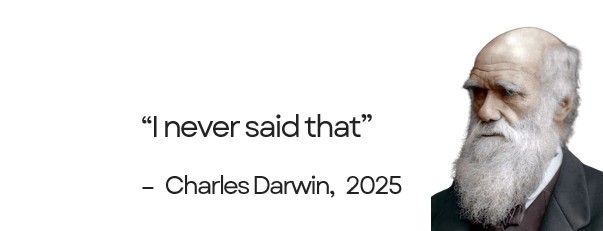
    These two phrases, by the way, were never actually used by Darwin himself. He never wrote of “survival of the fittest”, and the “struggle for life” was an existing economic concept that he borrowed to explain the evolutionary struggle for existence. The misconception that life revolves solely around merciless competition has not only caused historical harm, but continues to influence how we think about success, power, and exclusion.

    As an evolutionary biologist, I feel responsible for revealing these distortions and show that evolution, like language, is all about complexity, cooperation, and diversity, NOT a justification for inequality.

    Evolution is not a purely competitive process, but a dynamic equilibrium in which species – and here I want to emphasize species as a group, not individuals – adapt to changing conditions. Sometimes that means competition, but just as often, if not more so, it means cooperation. Species don’t survive exclusively through struggle, but primarily through interdependence, within and between species. Think of the flowers and the bees, quite literally: without each other, they would struggle to survive.

    Today, we see a strong resistance to policies that focus on diversity and inclusion. Often, this resistance stems from a desperate attempt to preserve a nostalgic ideal that in reality never even existed. But survival is about adaptation and change. Species that can’t adapt go extinct.

    And the only path to adaptation is through natural diversity. There is still plenty to learn in biology, but one principle has become very clear and is widely accepted: if diversity disappears, the system collapses. This applies to every level, from genetic diversity to biodiversity, and by extension neurodiversity. If we keep destroying what makes adaptation possible by failing to care for each other and for nature, then we ensure our own extinction.

    So far, my research has thought me that in language structure and meaning go hand in hand: structure creates meaning, and meaning creates structure. But what if structure restricts meaning?

    Today, I stand here, recognized and celebrated. Yet, something like this is by no means guaranteed. There are countless groups of people around the world who are actively hindered every single day, not only in their careers, but in their very lives. Not because they aren’t good or strong enough, but because systems, structures, and unwritten rules block their path. Because meaning is decided by the majority. Because there isn’t enough budget for inclusion. Because people are afraid of anything different. Because this is “simply the way society works”.

    But small changes aren’t actually that difficult to achieve, and don’t even have to cost a thing. At this moment, I have no power, no budget (the money hasn’t been transferred yet), and no policy behind me. But as a human, as a complex biological structure, I can decide that today, right here, I will bend and change one of the unwritten rules. The one minute silence. Normally, we use this time to reflect on past mistakes. But since history keeps repeating itself, and we’re visibly slipping back into a fearful past, I hope it’s clear that only looking back is never enough.

    So now I ask you for a minute of silence. Not out of respect for what once was, but to think about what still could be. About the structures that actively exclude people. About the rules we follow blindly without questioning. About the choices we can still make. As a tribute to all the people whose voices are silenced, denying them a full life.

    And after that, I don’t want any applause.

    I know the norm dictates that you should all clap at the end of my speech, but I don’t want that. I don’t want closure, no moment of self-satisfaction, and no collective sense of relief that the uncomfortable silence has finally come to an end. I want to finish with that discomfort. Because true change only begins when we allow ourselves to feel that discomfort.


© Kat Van der Poorten 2024 – 2025

FWO

Onderzoek gesteund door Fonds Wetenschappelijk Onderzoek Vlaanderen
en Lees- en Adviesgroep Volwassenen met Autisme