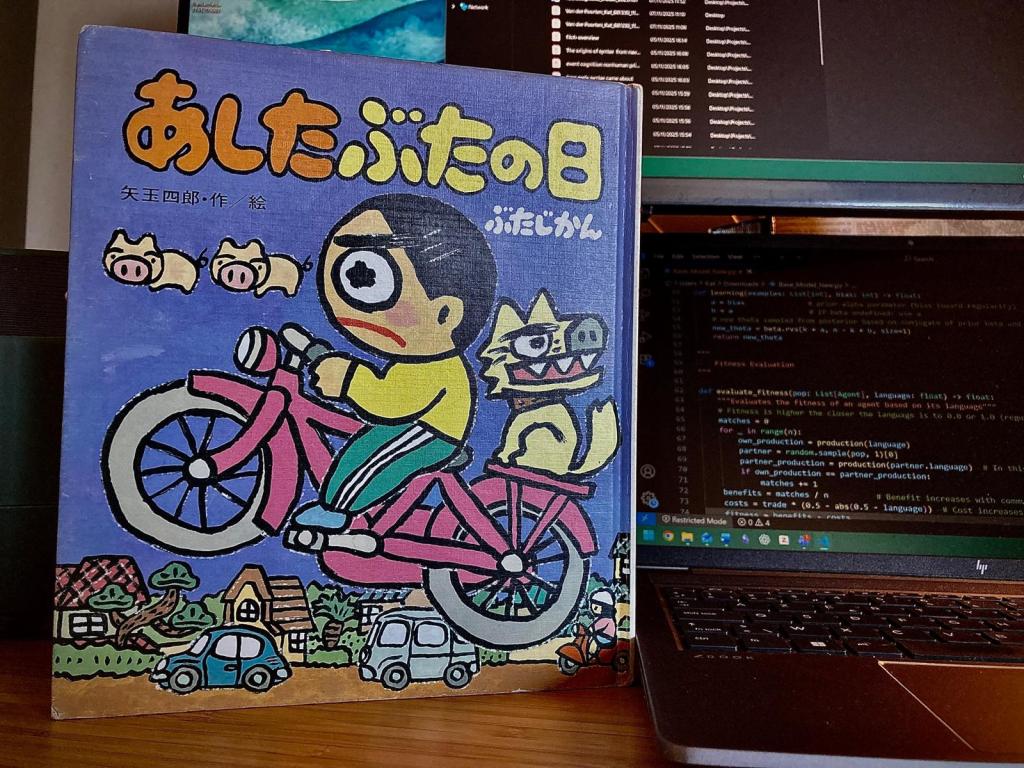
In a Japanese children’s book titled Ashita Buta no Hi (あしたぶたの日) – Tomorrow is Pig Day – author and illustrator Yatama Shirō constructs a world that quietly collapses under its own absurdity. The story begins in the ordinary as a young boy narrates his day. Then, without warning, pigs begin to appear: in classrooms, on the street, in the sky. They multiply and invade every corner of daily life.
The boy, accompanied by his irritable dog (who, for reasons never explained, has the snout of a pig), tries to carry on as if reason still applies. But every attempt to impose order only deepens the chaos. By the final page, he stops resisting. “Tomorrow is Pig Day,” he declares, not as prophecy or celebration but as resignation. The absurd has become routine.
Yatama’s work belongs to a lineage of Japanese ‘nonsense literature’ (ナンセンス文学), a form that embraces the collapse of logic as both comedy and critique. Beneath its cartoonish surface, Ashita Buta no Hi reads like a parable about systems that no longer serve meaning – where procedure has replaced purpose, and survival requires a wry acceptance of incoherence.
For anyone who has spent time inside modern academia, this story feels eerily familiar.
The academic world promises order, inquiry, and the shared pursuit of knowledge. Yet its daily reality more resembles Yatama’s Pig Day: endless activity, little coherence, and an undercurrent of collective frustration. Researchers scurry between deadlines, grant applications, and publication quotas, all while claiming to serve the ideal of truth. The system generates an extraordinary volume of output but starves genuine curiosity. Everyone is busy; few are allowed to truly think.
The irony is that these structures were designed to sustain intellectual life, yet they now constrain it. Departments and disciplines have become pens; each filled with researchers rooting in their own patch of soil, often unaware that the pen next door houses others asking the same questions. The very architecture of academia isolates rather than connects, rewarding specialization over synthesis.
Interdisciplinarity – the fragile art of crossing boundaries in search of deeper understanding – does not thrive under such conditions. It requires patience, dialogue, and uncertainty: all things our institutions have learned to treat as inefficiencies. The logic of productivity demands measurable outcomes, and so we measure the measurable. Tomorrow is Pig Day again.
In Yatama’s story, the boy’s anger is not petulance but lucidity. He sees that the world around him has stopped making sense and refuses to pretend otherwise. That is a scholar’s task too: to stay awake in the absurdity. To keep pointing to the incoherence, even when the system insists it is normal.
Perhaps that is the only kind of resistance still available: to continue asking real questions in a world too busy to listen. We can insist that inquiry is not a product, that wonder is not inefficiency, and that the value of knowledge lies not in output but in the questions that refuse to be domesticated.
If tomorrow must be Pig Day, then let it at least belong to those who still notice the pigs.



 kathetgedacht